 English
 Deutsch
 Français
 Español
 Nederlands
 Polski
 Italiano
 Română
 Türkçe
 Português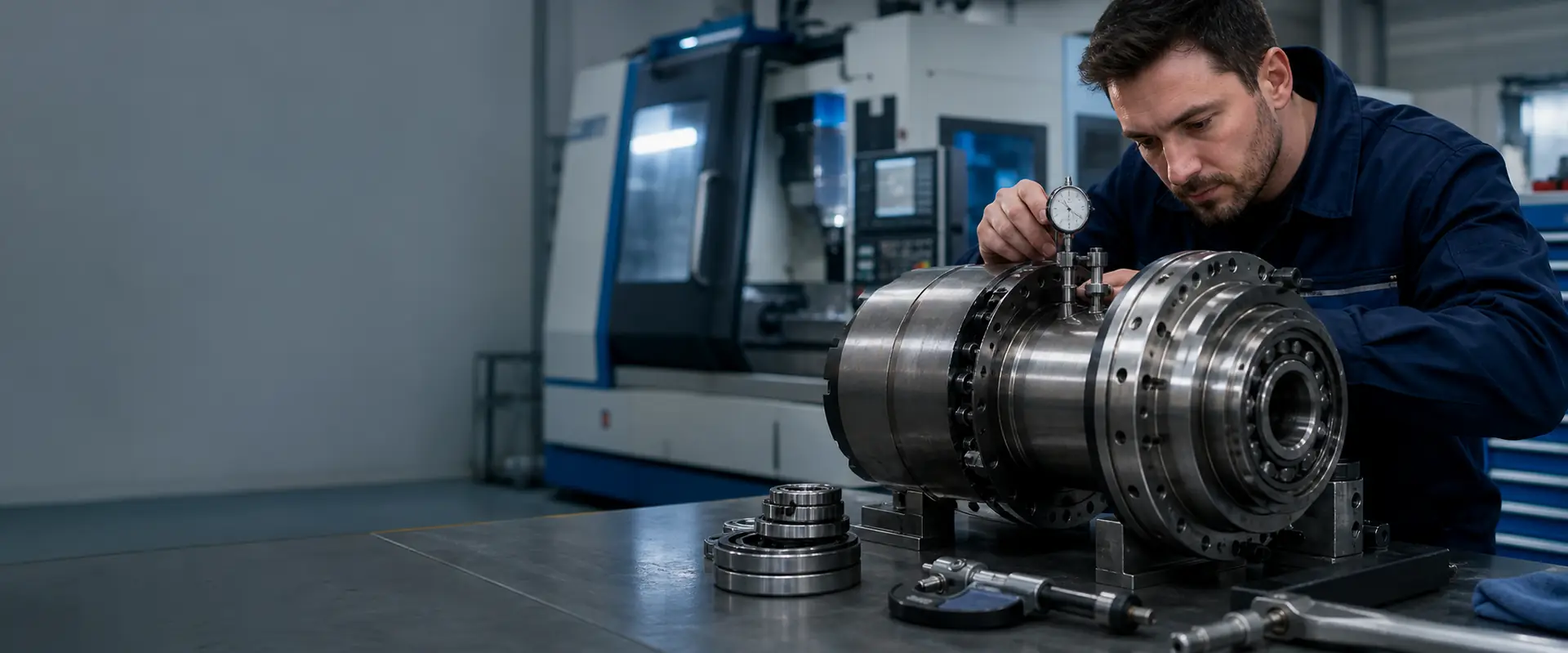
Machine brand
Hermle Spindle Repair and Rebuild
We rebuild spindles from Hermle machining centres in our own workshop in Sankt Augustin, Germany. The work is mechanical: strip, measure, report, then rebuild with new bearings and the preload set for that spindle type. We are an independent business, not authorised by or connected to the machine builder. Send the spindle in, or ask about on-site removal and refitting by prior arrangement.
Scope
Hermle spindle systems we work on
Hermle builds its five-axis machining centres around thermal symmetry: mineral-cast bases, a gantry structure, and a milling head that is expected to hold position as the machine warms. Owners of these machines therefore tend to notice a spindle problem as dimensional drift over a shift, not as noise. So we measure growth and preload behaviour warm as well as cold, rather than judging a spindle only by how it sounds on the bench.
HSK-A63 high-speed motor spindles
The common fit on the smaller C-series machines. The rotor sits on the shaft, so a winding problem, a bearing problem and a cooling problem all present as heat. These are stripped completely, the stator and cooling jacket checked, and the bearing set replaced and preloaded for that spindle type.
HSK-A100 high-torque spindles
Heavier units from the larger machines, usually run at lower speed with more cutting load through the front bearing pair. Wear tends to sit at the front. We check the housing bores and shaft seats for fretting before fitting bearings, because a worn seat will lose preload again within weeks.
Spindles with through-tool coolant
Coolant is fed through a rotary union at the rear and along the shaft bore. A leaking union sends emulsion into the rear bearing, and the bearing damage is then the symptom rather than the cause. The union, seals and shaft bore are inspected as one assembly.
Older cartridge and belt-driven heads
Units from earlier UWF and C-series machines still turn up, often with a belt drive rather than an integral motor. Parts can be slower to source. We measure first and say what is realistically available before any strip work is quoted, so nothing is bought blind.
The exact configuration depends on the machine model and the year of manufacture. Two machines with the same model designation can carry different spindle units, so we confirm the build from your nameplate photograph before quoting.
Symptoms
Faults we see most often on Hermle spindles
Noise and rising vibration
Usually the front bearing set. On a machine this stiff the noise often reaches the operator through the structure before the finish suffers. We strip, measure and rebalance to a defined grade.
Overheating and thermal drift
The complaint we hear most on Hermle machines, because thermal growth shows up directly in the part. Causes range from preload set too tight to a blocked cooling circuit or failing grease.
Runout at the taper
HSK contact faces mark easily after a crash or a bad tool change. The face and taper are reground where there is material to do it; if the shaft is bent we say so first.
Tool clamping problems
Drawbar force falls off as the disc springs settle or the collet segments wear. We measure clamping force before and after, and report the figure rather than just replacing the pack.
Encoder and orientation faults
Orientation errors during tool change often point at the spindle encoder, its cabling or a shifted reference mark. The mechanical side is ours; a control or drive fault is identified as such.
Coolant or grease ingress
Emulsion past a worn front seal, or grease migrating from a failed bearing, both leave the same mess. We report where the seal path failed so the same thing is less likely again.
Process
What a repair looks like
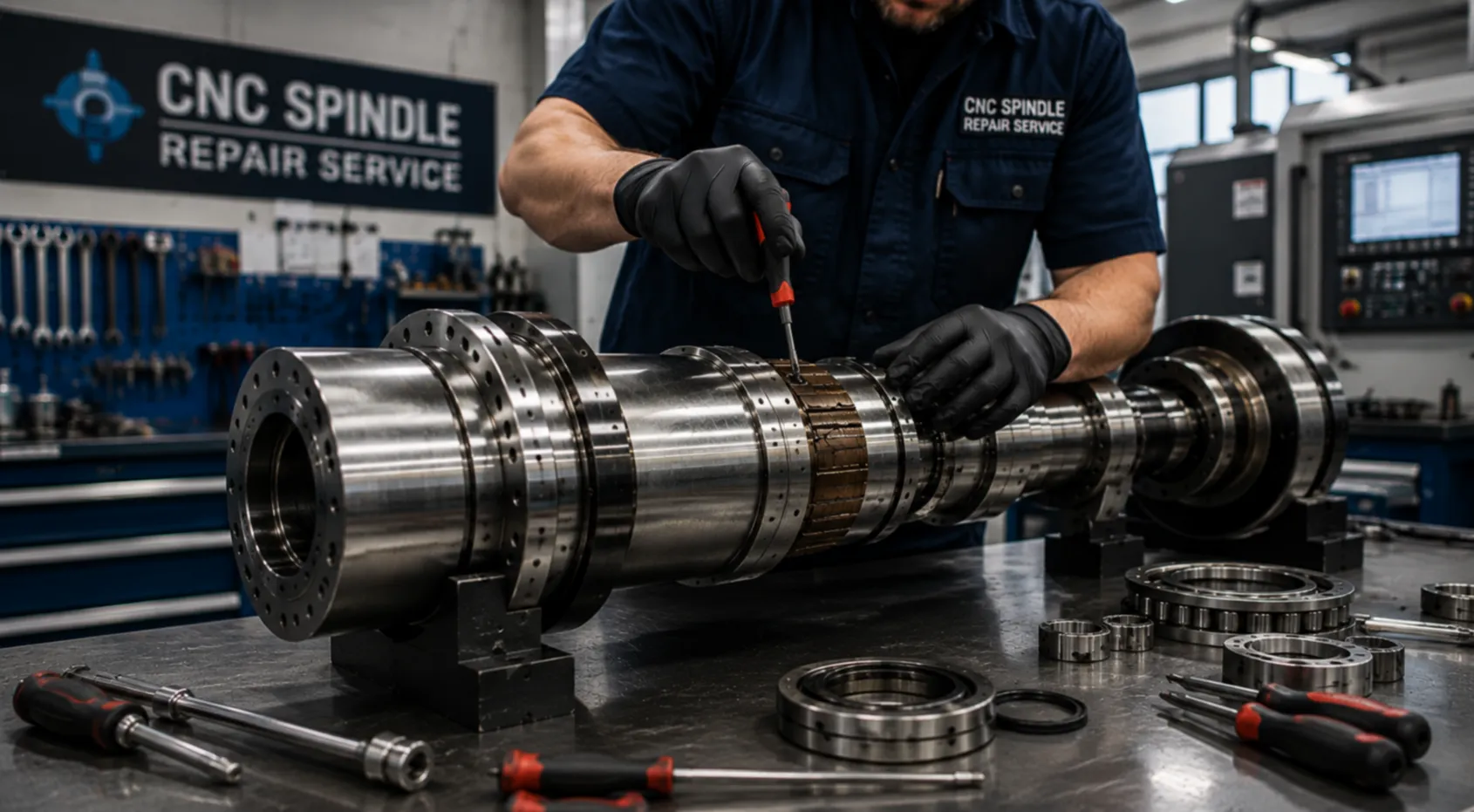
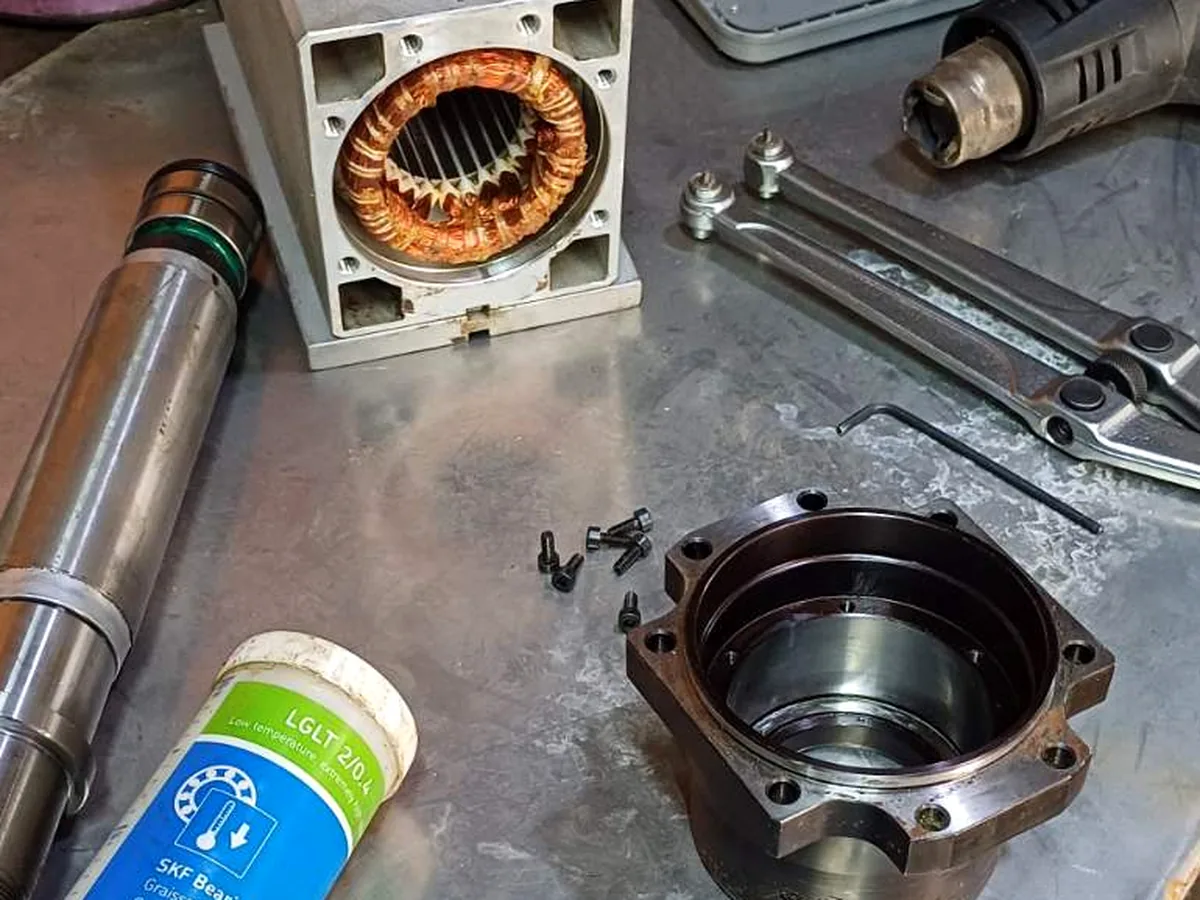
The spindle is logged in and inspected on arrival, then dismantled completely. We measure shaft and housing geometry, check the bearing seats, inspect windings and encoder, and photograph what we find. You receive a written quotation with the scope of work before anything is repaired. After the work is done the unit is dynamically balanced, run-in tested and shipped with a test report containing the measured values.
The individual operations — bearing replacement, rotor and stator rewinding, taper regrinding, drawbar and clamping repair, encoder work, seal and cooling circuit overhaul — are described on the services section of our homepage. On a Hermle spindle they are usually combined into one rebuild rather than ordered separately.
What to send with your enquiry
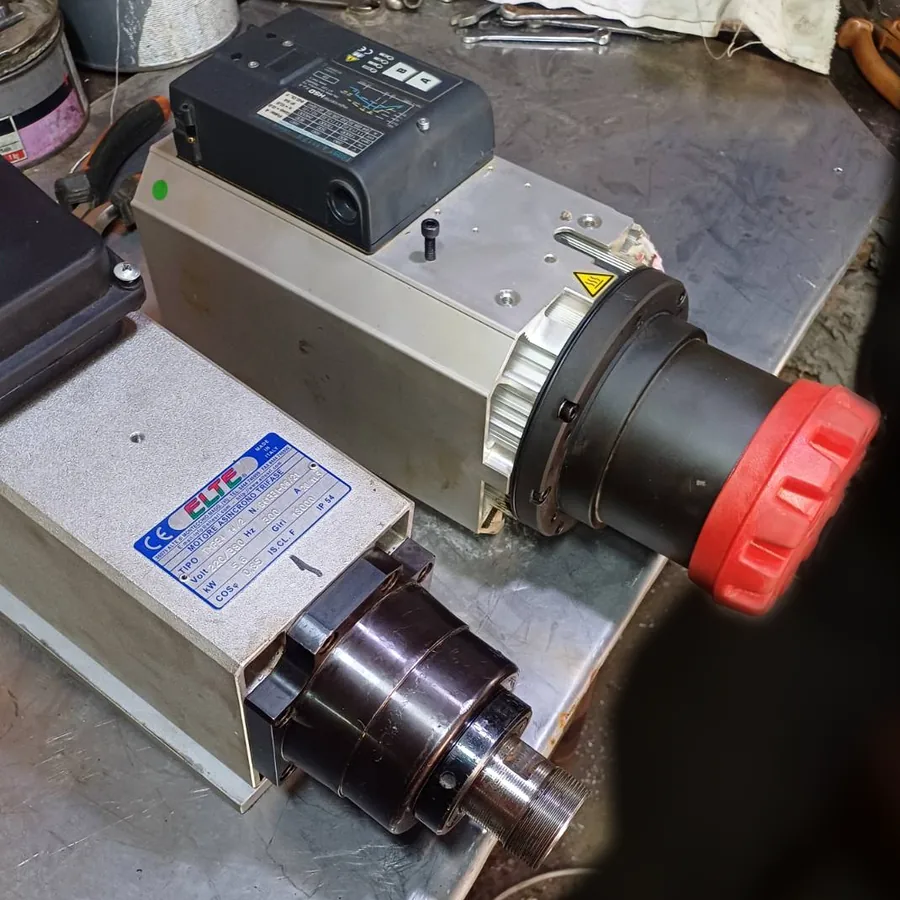
- Photographs of the spindle nameplate and of the tool interface
- Machine model, spindle type and year of manufacture
- A short description of the symptoms and when they appear
- Any measurements you already have — runout, temperature, vibration, current draw
- Whether the machine is still assembled or the spindle is already removed
Removal should be carried out by qualified personnel following the machine documentation. If that is not possible on site, ask us about removal and refitting as part of an on-site visit.
Shipping and on-site service
International jobs are handled through direct technical coordination, reliable freight planning and, where appropriate, a scheduled visit to the machine. Customers outside Germany send the spindle to us by freight forwarder; we inspect, repair, test and return it. On-site work — removal, installation, alignment and commissioning — is possible internationally, but only after the job has been agreed technically in advance, so that the right parts and instruments travel with the technician.
Questions
Hermle spindle repair — frequently asked
Yes. We are an independent workshop, so a spindle can come to us directly from your maintenance department. There is no dealer in the middle and we are not tied to one manufacturer's parts catalogue. What we cannot do is claim any form of Hermle authorisation. We have none, and we say so plainly on every page.
Units reaching us usually come from the C-series five-axis machining centres, C 12 through to the larger C 62, along with some older U and UWF machines still in daily use. That is a description of what arrives here, not a compatibility list. Send the spindle number and we will tell you whether it is something we can take on.
Preload is set for the spindle type and the duty it runs, not to a single universal figure. Too tight and the unit runs hot and drifts; too loose and stiffness suffers. After assembly the spindle is run in through a stepped speed cycle with temperature logged, so the warm behaviour is seen before it leaves. Results depend on what the teardown revealed.
Typically five to ten working days from arrival, depending on parts availability and what the teardown reveals. That is an estimate, not a committed date; a binding date is only valid if confirmed in writing. For customers in Germany, transport each way is usually short, which helps the overall turnaround. Removal and refitting on site can be arranged in advance.
The spindle is stripped and measured, and you receive a written quotation covering the parts and labour before any repair work begins. Nothing is machined or ordered until you have accepted it in writing. If you decide not to proceed, the unit is reassembled to a transportable state and returned. Ask us for the current inspection charge when you make contact.
Send us the spindle details
Tell us the machine model, the spindle type and what the machine is doing wrong. We come back with an initial assessment and a written quote before any work begins.
Scope
Spindle work we carry out for customers in Hermle
Every operation below is done in our own workshop in Germany. Follow a link for what it involves and what we need from you.
Machine brand
Machine brands
We are independent and not tied to any builder. These are the makes whose spindles come across the bench most often.