 English
 Deutsch
 Français
 Español
 Nederlands
 Polski
 Italiano
 Română
 Türkçe
 Português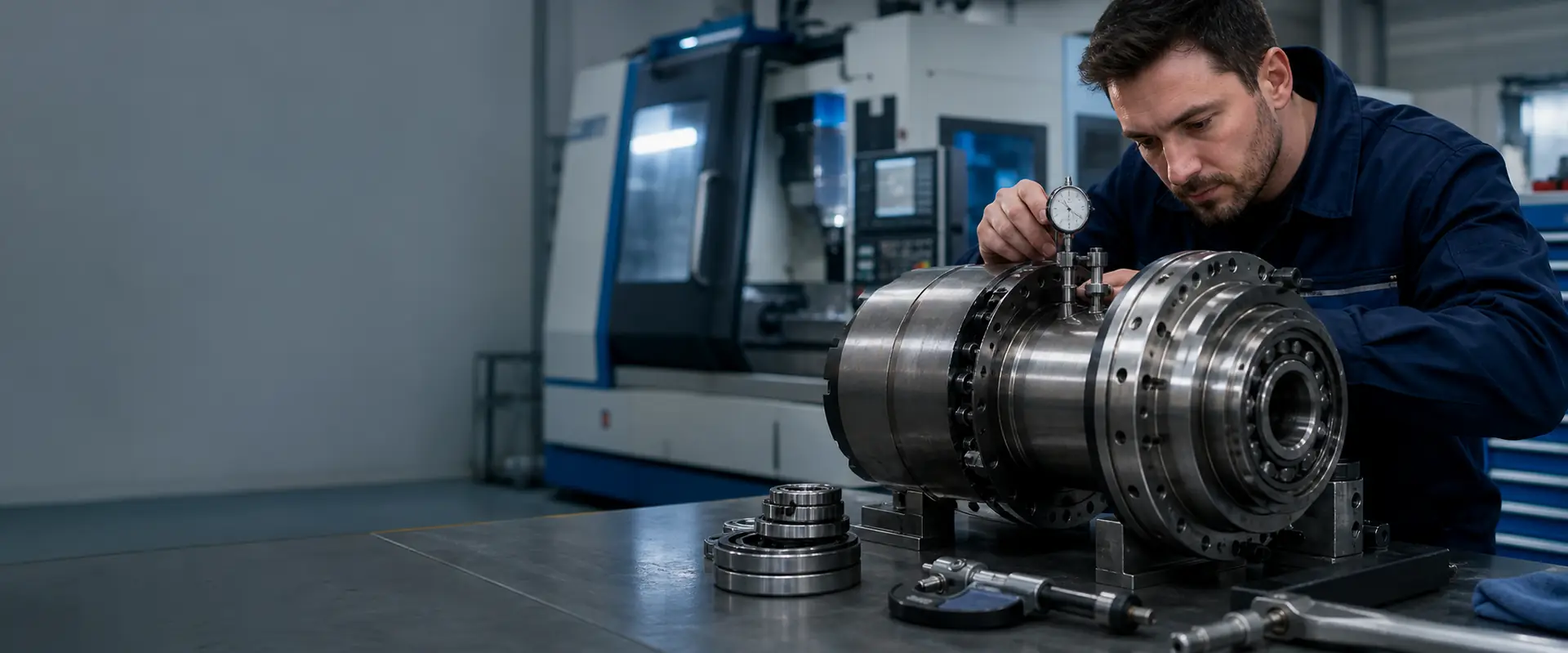
Field work
On-site spindle installation and commissioning
Not all of the work happens in the workshop. A spindle has to come out of the machine, and the rebuilt unit has to go back in, be aligned, commissioned and run in. Where that is wanted, a technician travels with the instruments and the parts the job has been agreed to need.
Scope
What an on-site visit can cover
Field work is planned work. What can be achieved on your shop floor depends entirely on what has been agreed beforehand, because the pullers, the tooling, the measuring instruments and any parts all have to be loaded before the technician sets off. A visit arranged around a clear technical picture achieves something; one arranged around a vague description usually does not.
Removal and refitting at the machine
The spindle is removed, packed for transport and, once the workshop work is finished, refitted. Mounting faces, clamping bolts and the condition of the machine interface are checked while access is still open.
Alignment in the machine
Where the design calls for it, the spindle is aligned to the machine axes and the mounting checked for seating. A rebuilt spindle bolted into a distorted mounting will not run as it did on the test stand.
Commissioning and run-in
Lubrication, air supply and cooling are connected and checked, then the spindle is run in stepwise through its speed range with temperature monitored at each step, rather than being taken straight to full speed.
Vibration measurement on the machine
Vibration is measured in the machine at the speeds you actually cut at. That is a different picture from a test stand, and it is the one that says what the spindle will do in production.
Checklist
What has to be settled before travel
- Machine make, model and the spindle mounting arrangement
- Site address, access times and lifting provision
- Whether the machine will be free on the agreed day
- For work outside Germany, the arrangement agreed in writing
Process
How a site visit is arranged
-
1
Technical agreement first
Machine, spindle type, mounting, interfaces and the scope of the visit are settled in writing. That is what decides which instruments, tools and parts travel with the technician.
-
2
Date, access and preparation
A date is agreed and you confirm access: machine availability, crane or lifting provision, power, air and somewhere to work. Preparation on your side shortens the visit considerably.
-
3
The work on site
Removal or refitting, alignment, connection of lubrication and cooling, run-in and measurement, in whatever order the machine allows. Findings are recorded as the work proceeds, not afterwards from memory.
-
4
Handover and written record
The measured values from commissioning and the run-in are written up and handed over, together with anything noticed on the machine that ought to be dealt with separately.
Questions
On-site installation and commissioning spindle repair — frequently asked
By prior technical arrangement, yes. Technical support can be arranged at the machine when required, with tooling, measuring equipment and likely parts prepared for the reported fault. A visit abroad is possible where the job has been agreed in detail beforehand, since everything needed for it has to travel with the technician.
No. A rebuild needs a clean bench, presses, grinding and balancing equipment and measuring instruments that do not travel. On site we remove, refit, align, commission and measure. The repair itself is done in the workshop, and the spindle comes to us for it.
We report it. If the mounting is distorted, the drive is misbehaving or the structure is at fault, the spindle can be refitted correctly and the symptom will remain. You get the measurements and our reading of them, and work on the machine is then yours to arrange.
Travel, working time and materials are invoiced at the rates in our terms, and the expected scope is set out in writing before the technician leaves. If the job on site turns out to differ from what was agreed, we stop and discuss it rather than carrying on regardless.
When it is needed
When a technician on site makes sense
Nobody in-house to pull the spindle
The maintenance team has neither the pullers nor the experience to get the unit out without damaging the mounting, and a spindle damaged on the way out costs more.
The machine, not the spindle, is suspect
A spindle that runs correctly on the test stand and badly in the machine is saying something about the mounting, the drive or the structure. That gets measured where it happens.
Commissioning after a major rebuild
A high-speed spindle going back in after a bearing change benefits from a controlled run-in and measurement at operating speed, recorded on the machine rather than assumed from the test run.
Arrange a site visit
Send the machine make and model, the spindle type and what you need doing at the machine. We will tell you what a visit can realistically cover and what has to be agreed in advance.
Scope
Spindle work we carry out for customers in On-site installation and commissioning
Every operation below is done in our own workshop in Germany. Follow a link for what it involves and what we need from you.
Machine brand
Machine brands
We are independent and not tied to any builder. These are the makes whose spindles come across the bench most often.