 English
 Deutsch
 Français
 Español
 Nederlands
 Polski
 Italiano
 Română
 Türkçe
 Português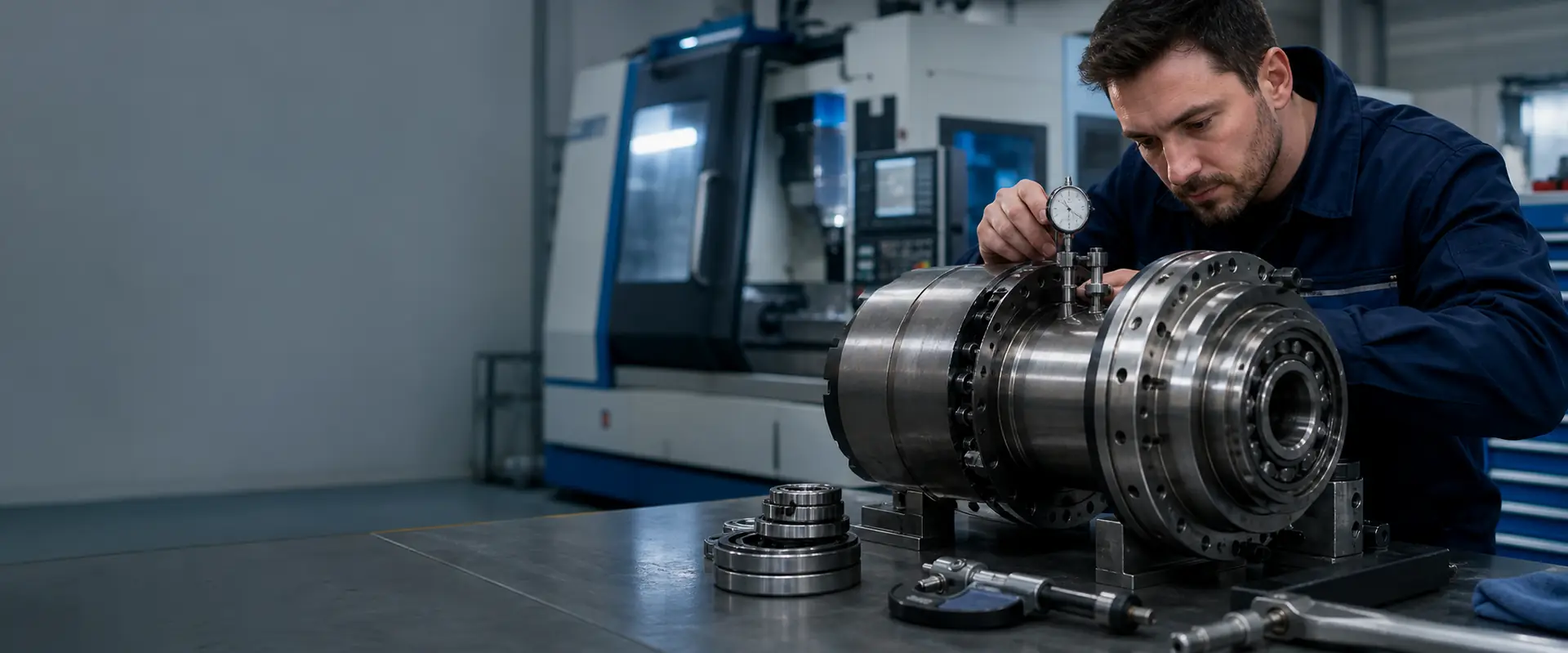
Machine brand
DMG Mori Spindle Repair and Rebuild
We overhaul DMG Mori spindles: speedMASTER and powerMASTER motor spindles, five-axis head spindles, turning main and counter spindles, and driven tool units. Everything is done in our workshop in Sankt Augustin, Germany, as an independent business working on all machine brands. Ship the spindle to us, or ask about on-site work, which is arranged in advance and only where it makes technical sense.
Scope
DMG Mori spindle systems we work on
DMG Mori grew out of two engineering traditions, the German Gildemeister line and the Japanese Mori Seiki line, and the spindles still reflect that. A milling spindle out of a DMU is not built like a turning spindle out of an NLX, even though the badge is the same. So we work from the spindle number and the machine serial rather than the brand name when deciding what a unit needs.
speedMASTER motor spindles
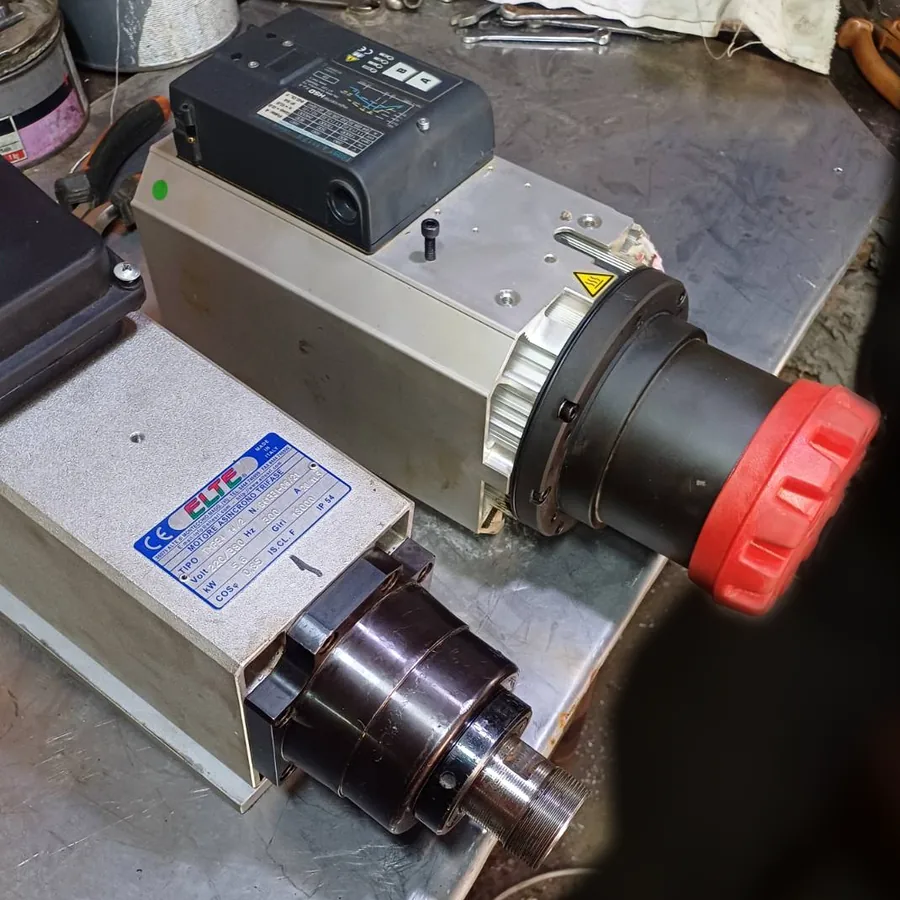
Built-in motor units with an HSK interface, usually out of DMU and DMC milling machines. The rotor sits on the shaft, so winding, bearing and cooling faults present alike. We strip completely, measure winding and insulation, and rebuild with the preload specified for that spindle type.
powerMASTER high-torque spindles
Heavier units built for roughing, with more mass in the rotor and a cooling circuit that has to work properly. When they fail it is usually the front bearing set, after a long spell of interrupted cutting. Rebuild covers bearings, taper condition, the cooling jacket and balancing of the assembly.
Five-axis head spindles
Swivel head and trunnion units from monoBLOCK and duoBLOCK style machines, where the spindle sits in a head that also carries torque motor axes and clamping. Alignment matters as much as the bearings, so the head is measured before and after the spindle work is done.
Turning and Sprint sliding-head spindles
Main and counter spindles from CTX, NLX and NTX lathes, and the small driven tool spindles in Sprint sliding-head machines. Bar and chuck loads, or in the Sprint case sheer speed and a wet environment, decide what wears. Bearings, seals and spindle nose runout are all measured.
The exact configuration depends on the machine model and the year of manufacture. Two machines with the same model designation can carry different spindle units, so we confirm the build from your nameplate photograph before quoting.
Symptoms
Faults we see most often on DMG Mori spindles
Noise and rising vibration
On speedMASTER units the noise usually changes in one speed band first. We strip, measure bearing seats and shaft geometry, and balance the rotating assembly to an ISO 21940 grade suited to the speed.
Overheating and thermal drift
Motor spindles with blocked or scaled cooling circuits drift thermally long before they fail outright. We check the jacket, the bearing preload and the grease or oil-air supply rather than reading the alarm alone.
Runout at the taper
HSK faces pick up after a crash or after tool changes under load. The taper and face are reground and runout corrected against the journals; a bent shaft is reported before further work.
Tool clamping problems
Clamping force falls as the spring stack tires, and on an HSK interface the face contact goes first. Force is measured, the collet segments and springs are renewed, and the release stroke is reset.
Encoder and orientation faults
Orientation problems on five-axis heads can come from the spindle encoder or from the torque motor axis feedback. We test what is mechanically accessible on the bench and say clearly which side the evidence points to.
Coolant or grease ingress
High-pressure through-spindle coolant is common on these machines, and a tired rotary union or seal puts water into the bearings. Insulation resistance on built-in units is measured at intake, before anything is dismantled.
Process
What a repair looks like
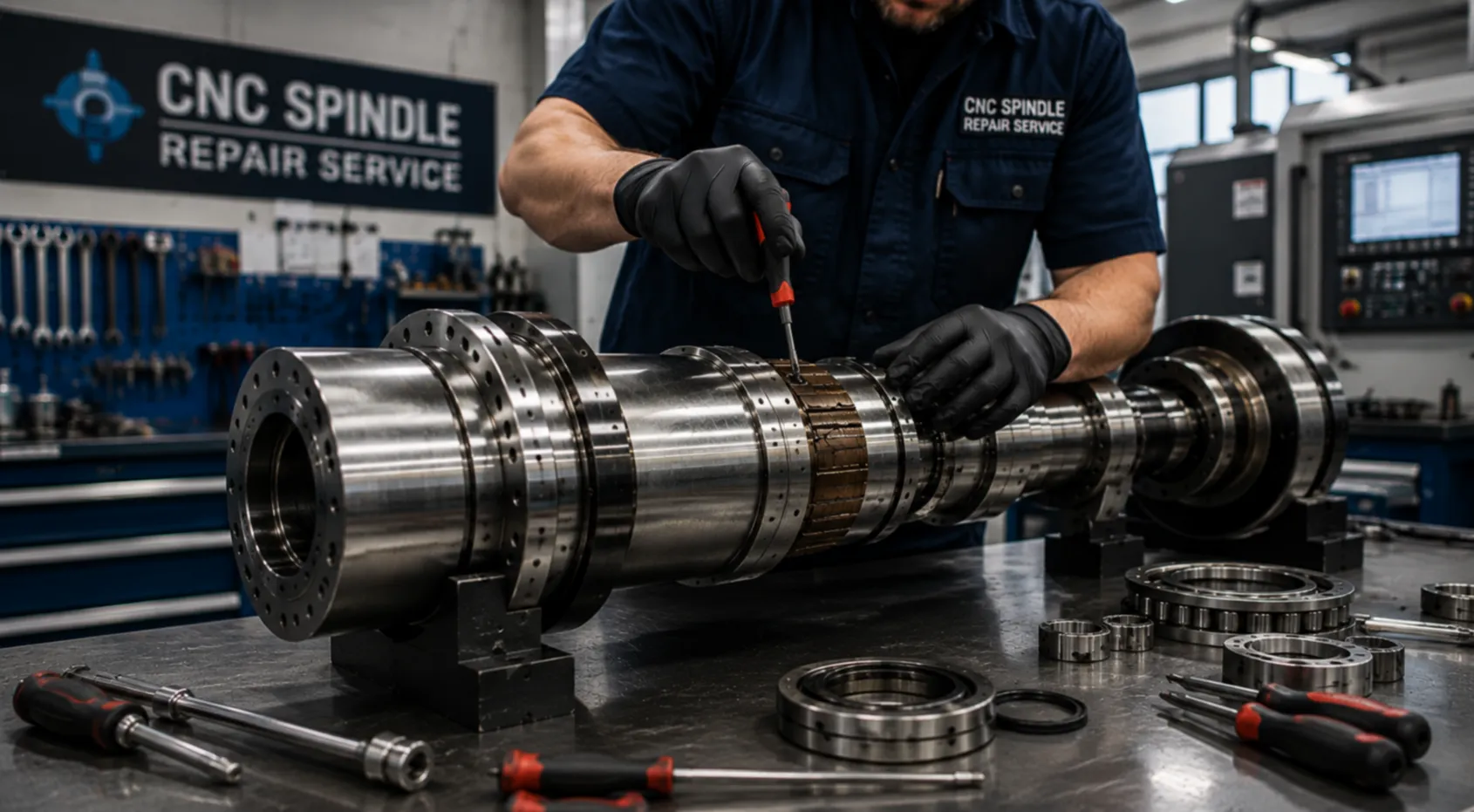
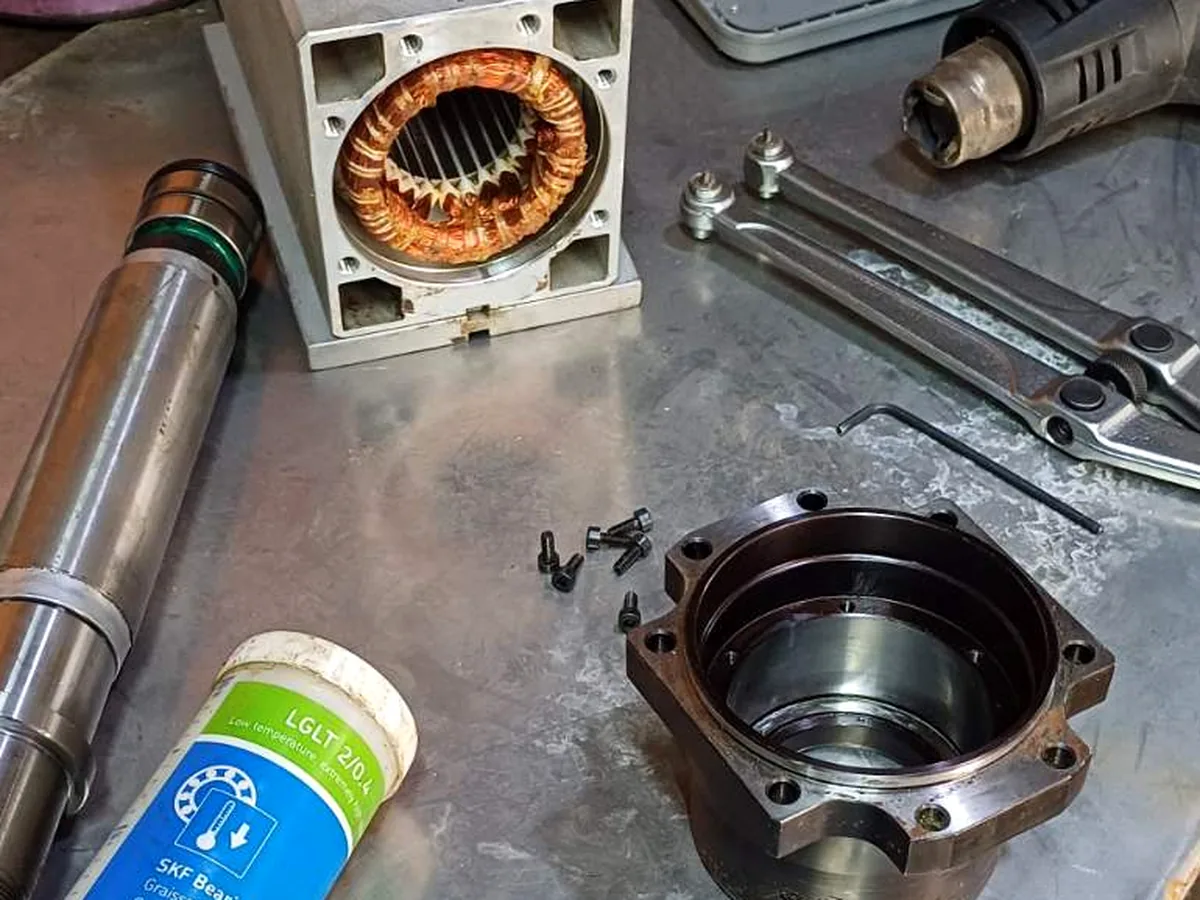
The spindle is logged in and inspected on arrival, then dismantled completely. We measure shaft and housing geometry, check the bearing seats, inspect windings and encoder, and photograph what we find. You receive a written quotation with the scope of work before anything is repaired. After the work is done the unit is dynamically balanced, run-in tested and shipped with a test report containing the measured values.
The individual operations — bearing replacement, rotor and stator rewinding, taper regrinding, drawbar and clamping repair, encoder work, seal and cooling circuit overhaul — are described on the services section of our homepage. On a DMG Mori spindle they are usually combined into one rebuild rather than ordered separately.
What to send with your enquiry
- Photographs of the spindle nameplate and of the tool interface
- Machine model, spindle type and year of manufacture
- A short description of the symptoms and when they appear
- Any measurements you already have — runout, temperature, vibration, current draw
- Whether the machine is still assembled or the spindle is already removed
Removal should be carried out by qualified personnel following the machine documentation. If that is not possible on site, ask us about removal and refitting as part of an on-site visit.
Shipping and on-site service
We coordinate collection, technical assessment and return transport directly, with planned on-site support available for diagnosis, removal or commissioning. Customers outside Germany send the spindle to us by freight forwarder; we inspect, repair, test and return it. On-site work — removal, installation, alignment and commissioning — is possible internationally, but only after the job has been agreed technically in advance, so that the right parts and instruments travel with the technician.
Questions
DMG Mori spindle repair — frequently asked
Yes. Send the unit straight to the workshop; there is no dealer step, and no single parts catalogue we are obliged to buy from. We are an independent repair business in Germany with no DMG Mori authorisation, approval or affiliation, and we prefer to say that at the start rather than let it be inferred.
Units reaching us usually come from DMU and DMC milling machines, monoBLOCK and duoBLOCK five-axis machines, CTX, NLX and NTX lathes and Sprint sliding-head machines. That is simply what we see most often. It is not a compatibility statement, so send the spindle number and we will say what is realistic.
In most cases it can be rebuilt. What decides it is the state of the shaft and the winding once the unit is open. A scored bearing seat can usually be repaired; a bent shaft or a badly damaged rotor often cannot be repaired economically. We report which of those we have found before quoting the work.
Typically five to ten working days from arrival, depending on parts availability and what the teardown reveals. Treat that as an estimate rather than a committed date; a binding date is only valid if we confirm it in writing. Five-axis head units can take longer, since the head alignment has to be measured as well.
There is a charge for the assessment, and it depends on the size and type of spindle. The unit is stripped, measured and photographed, and you receive a written quotation before any repair work starts. Tell us the spindle number and we will tell you what the inspection will cost and what it covers.
Send us the spindle details
Tell us the machine model, the spindle type and what the machine is doing wrong. We come back with an initial assessment and a written quote before any work begins.
Scope
Spindle work we carry out for customers in DMG Mori
Every operation below is done in our own workshop in Germany. Follow a link for what it involves and what we need from you.
Machine brand
Machine brands
We are independent and not tied to any builder. These are the makes whose spindles come across the bench most often.