 English
 Deutsch
 Français
 Español
 Nederlands
 Polski
 Italiano
 Română
 Türkçe
 Português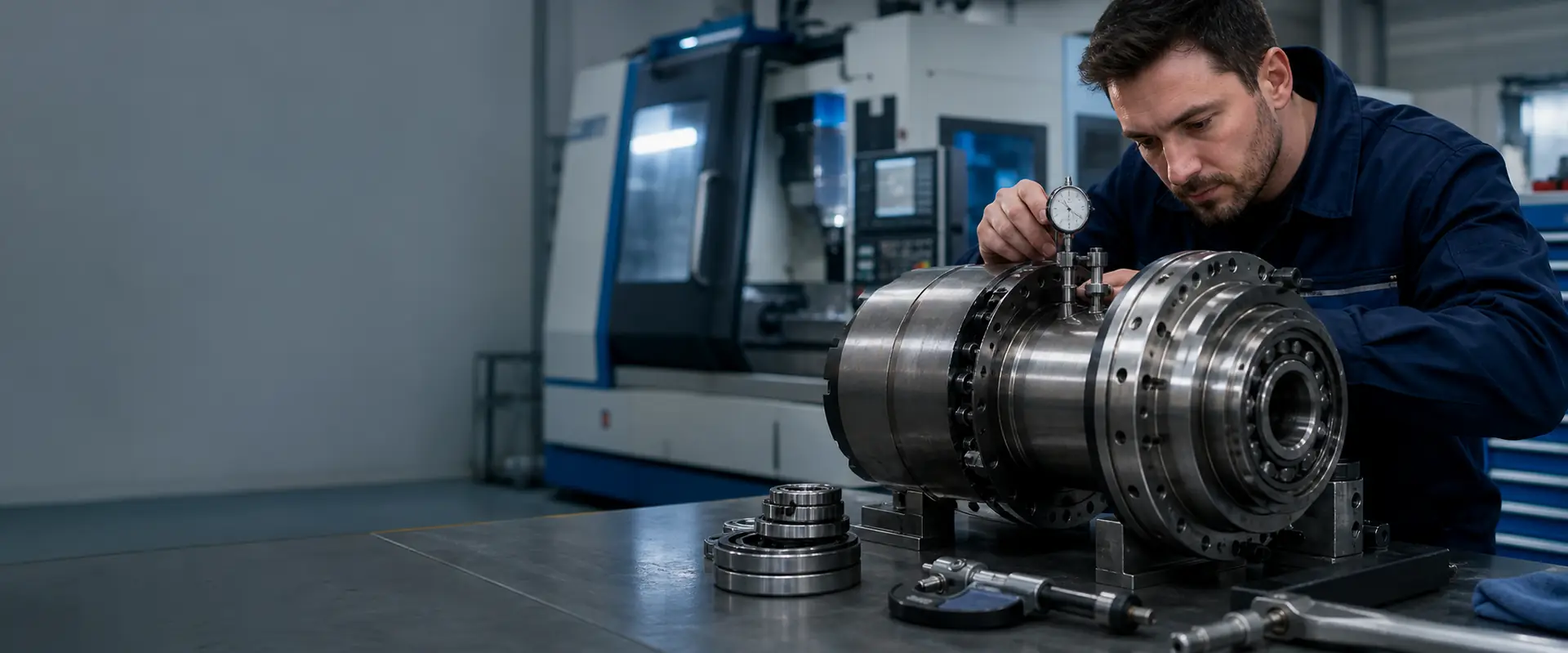
Machining
Spindle housing repair and regrinding
Bearings sit in a seat, and the seat wears. A bore that has fretted, or a shaft journal that has let an inner ring turn, will not hold new bearings for long whatever is fitted into it. This work brings those seats back to size, or establishes that the housing has reached its end.
Scope
What a seat repair involves
Housing work is measurement first and machining second. Diameter on its own says very little; roundness, cylindricity and the alignment of one seat to the next decide whether new bearings will sit true. Only once those figures exist can anyone say whether a seat can be brought back to size, and whether the housing is worth the cost of doing it.
Measuring bore and journal geometry
Each seat is measured cold for diameter, roundness and cylindricity, and the seats are checked for alignment with one another. Fretting corrosion, a polished witness ring and a stepped bore all read differently on the gauge.
Sleeving and re-machining a bore
A worn bore is machined oversize and a sleeve fitted, then bored back to nominal size and fit. Where the wall thickness will not carry a sleeve, we say so rather than fitting a thin one.
Shaft journals brought back to size
A journal that has let an inner ring spin is ground undersize and built back up, then reground to the original diameter and tolerance. Concentricity is checked against the remaining running surfaces on the shaft.
Coolant channels and seal seats
Coolant passages, labyrinth grooves and the seats carrying the seals are cleaned, checked and re-cut where damaged. A repaired bearing seat behind a leaking seal only postpones the same failure by a few months.
Process
From measurement to a finished seat
-
1
Strip and clean the housing
The housing is emptied, cleaned and inspected for cracks, thread damage and earlier repairs. Old sleeves and adhesive residue come out before anything is measured.
-
2
Record the geometry
Bores, journals and shoulders are measured and the values written down against the drawing figures or, where none exist, against the fits the bearings themselves require.
-
3
Decide, then quote
You are told what is worn, what can be recovered and what it costs, including the point at which a replacement housing is the cheaper answer. Machining starts after that.
-
4
Machine and verify
Sleeving, boring or grinding is carried out and the finished seat measured again for size, roundness and alignment. Those figures go into the report that travels with the spindle.
Checklist
What helps when quoting housing work
Housing work is priced on what the measurement shows, so any fit data or drawings you have help us compare the actual dimensions with the original specification. The repair history matters too: bearings that failed more than once in the same position are a strong hint that the seat, not the bearing, is the cause.
- Spindle type and any drawing or fit data you hold
- How long ago the spindle was last rebuilt
- Whether the bearings failed once or repeatedly
- Price and availability of a replacement housing, if known
When it is needed
Evidence that the seats have gone
Worn bearing seats are easy to miss because the spindle can run well for a while after new bearings are fitted. The problem shows when the same bearings fail again after a short time or when marks appear on the outer rings. These are the signs that the housing or shaft seats need measuring, not only the bearings.
Bearings that failed again quickly
A spindle rebuilt not long ago is noisy again. New bearings in a worn seat work loose, and the second failure usually arrives faster than the first one did.
Fretting rust at the fits
Reddish brown powder around a bearing seat, on the shaft or in the bore, means the fit has been moving under load. Material is already leaving the surface.
An inner ring that has turned
Scoring or a bright polished band on the journal, sometimes with the ring loose in the hand, shows the fit lost its interference well before the bearing itself failed.
Questions
Housing repair and regrinding spindle repair — frequently asked
When the wall around the bore is too thin to carry a sleeve, when the casting is cracked through a seat, or when machining costs approach the price of a serviceable housing. We give you the figures and our recommendation, and the decision stays with you.
Fitted correctly it typically does, and sleeving is normal practice in spindle work. The sleeve is an interference fit in cleaned material and bored to size in place, so the bearing sees one continuous seat. Where we doubt the material will carry it, we do not fit one.
No. Bearing seats sit behind the bearings and their geometry cannot be judged from outside the unit. Seat condition is established during the chargeable teardown, and any quotation for machining follows from those measurements rather than from an estimate made over the phone.
We repair and re-machine what comes in rather than building new housings. Where a housing is beyond saving we say so, and we will help you establish what a replacement has to be, but sourcing it from the machine or spindle manufacturer remains your side of the job.
Have the seats measured
Tell us the spindle type and how the last set of bearings behaved. If the seats are the reason the unit came back, that is established during teardown and quoted before any machining begins.
Scope
Spindle work we carry out for customers in Housing repair and regrinding
Every operation below is done in our own workshop in Germany. Follow a link for what it involves and what we need from you.
Machine brand
Machine brands
We are independent and not tied to any builder. These are the makes whose spindles come across the bench most often.