 English
 Deutsch
 Français
 Español
 Nederlands
 Polski
 Italiano
 Română
 Türkçe
 Português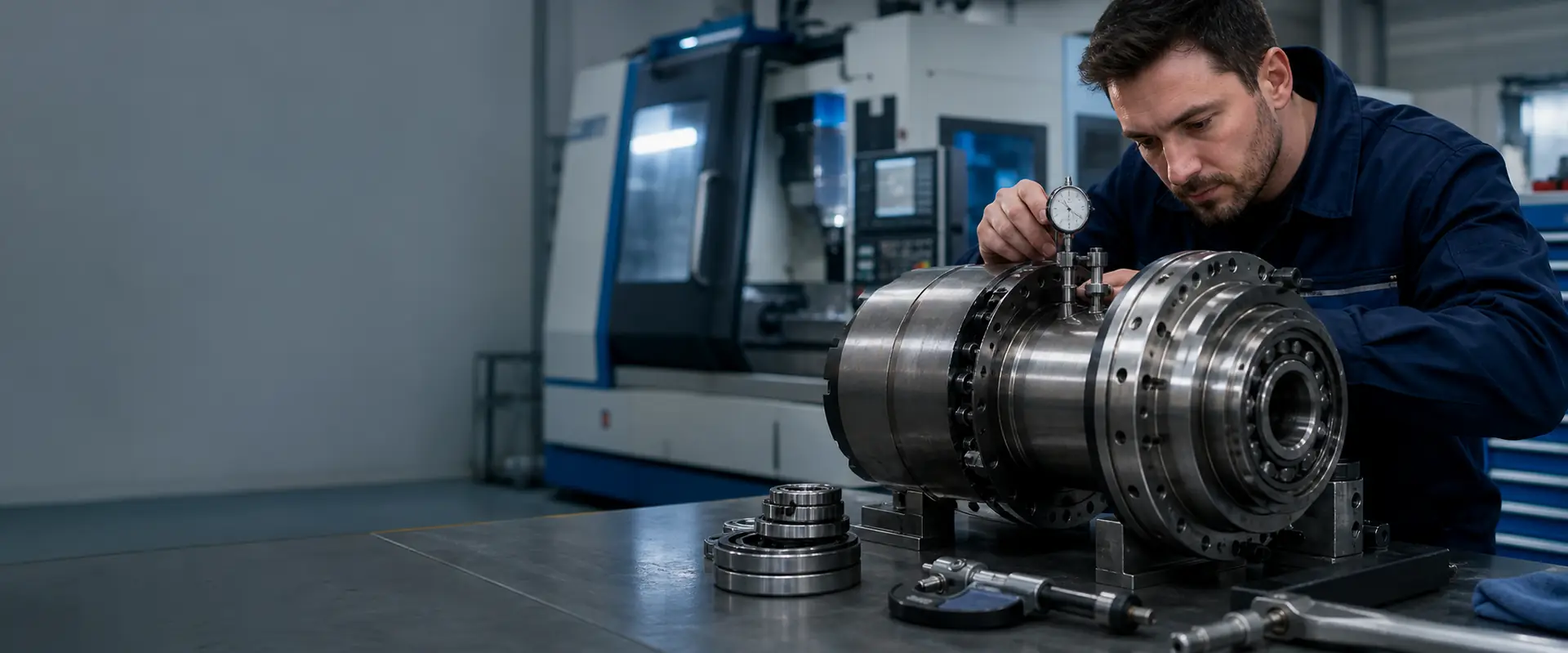
Maintenance
Preventive spindle maintenance
A spindle rarely fails without warning. Runout creeps up, the bearings get louder, the clamping force drops, the temperature after warm-up rises a few degrees. Preventive maintenance means measuring these values at fixed intervals, so a rebuild can be planned for a convenient date instead of arriving as a breakdown in the middle of a production run.
Scope
What a maintenance check covers
The check is a set of measurements taken the same way every time, so the values can be compared from one visit to the next. A single reading says little; the trend over several checks shows whether a spindle is stable or wearing.
Runout and taper condition
Radial and axial runout at the tool interface, plus the condition of the taper and the contact faces. Rising runout is often the first sign of bearing wear or a damaged taper.
Vibration and temperature
Vibration and bearing temperature recorded at defined speeds after warm-up. Comparing these values with earlier checks shows wear long before it can be heard.
Drawbar and clamping force
Clamping force measured with a gauge, because tired disc springs or a worn collet let the tool move under load and damage the taper.
Air, coolant and lubrication
Sealing air pressure and quality, oil-air or grease lubrication and the cooling circuit are checked, since many bearing failures start with contamination or a lubrication fault.
Process
How a maintenance programme runs
-
1
First measurement
On the first visit or with the first spindle sent in, we record the baseline values for each spindle and note its type, serial number and running hours.
-
2
Agreed interval
Together we set an interval that suits the machine and its duty, for example every six or twelve months, or after a fixed number of running hours.
-
3
Repeat checks and trend
Each check is measured the same way and compared with the previous values. You receive a short report with the readings and our assessment.
-
4
Planned repair
If a value moves out of its range, we recommend a repair date and can quote it in advance, so parts and machine downtime can be planned.
Checklist
What we need to set up a programme
To set up useful checks we need to know which spindles are involved and how they are used. Speeds, tool interface and daily running hours define which values to measure and how often. Earlier repair reports give a starting point, so the first visit does not begin from zero.
- List of machines and spindle types, with serial numbers if available
- Typical speeds, tool interface and daily running hours
- Any previous repair reports or known problems
- Whether checks should take place on site or in our workshop
When it is needed
When preventive maintenance pays off
Regular checks pay off most where a spindle failure stops more than one machine or where repairs take a long time. With measured values from several visits, wear becomes visible as a trend and a repair can be planned for a convenient time. These are the situations in which a maintenance programme is worth setting up.
Bottleneck machines
One machine carries a large part of the production and a spindle failure would stop delivery. Planned checks reduce the risk of an unplanned stop.
High-speed motor spindles
Motor spindles running at high speed are expensive to rebuild once a bearing has collapsed. Caught early, the repair is often limited to bearings and seals.
Several identical spindles
With a group of machines of the same type, comparable readings show quickly which spindle is wearing faster than the others.
Questions
Preventive spindle maintenance — frequently asked
Many measurements, such as runout, vibration, temperature and clamping force, can be taken at the machine. If a spindle needs to be opened, it comes to our workshop. On-site visits are arranged in advance.
It depends on the speed, the duty and how critical the machine is. Six to twelve months is a common starting point; the interval can be shortened if the readings start to move.
No. It cannot stop wear, but it shows when a rebuild is due, so the repair is smaller and can be planned instead of following a sudden failure.
A short report with the measured values, the comparison with earlier checks and our recommendation: continue running, check again sooner, or plan a repair.
Plan maintenance for your spindles
Send us the list of machines and spindle types. We will suggest a check interval and tell you which measurements make sense for your spindles.
Scope
Other spindle work in our workshop
Every operation below is done in our own workshop in Germany. Follow a link for what it involves and what we need from you.
Machine brand
Machine brands
We are independent and not tied to any builder. These are the makes whose spindles come across the bench most often.